Skins

From Meister Eckhart: “A human being has so many skins inside, covering the depths of the heart. We know so many things, but we don't know ourselves! Why, thirty or forty skins or hides, as thick and hard as an ox's or bear's, cover the soul.  Go into your own ground and learn to know yourself there. God expects but one thing of you, and that is that you should come out of yourself in so far as you are a created being made and let God be God in you. Do exactly what you would do if you felt most secure. God is at home, it's we who have gone out for a walk."

Caution: we shouldn't assume we know what Meister Eckhart meant by 'God' - John Caputo evokes this in referring to God as 'the event'; but all language about God, we must assume, is inadequate.  So, at the risk of editing Meister Eckhart for my own purposes, let me say that I'm not sure what he meant either, but I'm pretty sure he's right when he says that we have wandered from where things work better.  And I know I have several skins that need to be shed.

Someone with a long history of courageous spiritual activism, mystical presence, and religious discipline once said to me that 'the spiritual journey with Jesus is a motherf*****'.  She's a person who knows.  Shedding the skins that cover who I really am, or really want to be (and bearing in mind that sometimes my interpretation of who I really want to be is pretty well hidden under one of my many skins), is a battle not unlike the pain of growing teeth for the first time.  Moving into a new space means leaving an old one behind; opening oneself to the possibility of change for the sake of becoming more human isn't a walk in the park.  The spiritual walk with anyone is a motherf*****.

I've got to head out in a couple of minutes and am trying to find a way to end this post - I'm in two minds about even putting it up, but something in me tells me I should.  The need for caveats and clarifications has the potential to overwhelm the desire to write something meaningful - gotta explain what I mean by 'God', or what I mean by 'skin', or what I mean by 'motherf*****'... And I can't.  I'm not sure how much good it would do if I could - because anyone reading is going to bring their own interpretation to all of this anyway.  So let me just say this: whatever you think about God's Being or otherwise, the notion that Meister Eckhart advanced that we should 'do what we do if we were most secure in love' probably isn't a bad lens through which to view your life today.  I'm in LA right now; and so am about to step out the door into a city of busy traffic, rampant commercialism, and some of the most oppressive opportunities to compare oneself unfavourably to everyone you meet.  I'm not feeling particularly secure.  But in my imagination, something else is possible.
This Week

I've had a lot of feedback about my Naked post; and am happy that it has provoked some conversation.  I'll write more on this theme in the future - please feel free to post comments with suggestions or questions for what you'd like me to explore.  I'm particularly interested in writing about the interaction between spirituality and sexuality; along with the kinds of questions Michael Pollan and others are asking about our relationship to food and psychology. This week I'm in LA til mid-week, speaking yesterday at All Saints Beverly Hills and Risenchurch Santa Monica.  We had some fun talking about spirituality and the body; and today I'm trying to get some writing done before seeing 'The Hurt Locker'.  Kathryn Bigelow's film is being cited as her best  (which is seductive, given that 'Point Break' does what it's trying to do better than most other films of its kind; and that 'Strange Days' took cybertechnology and crime seriously before it became the cliched trope of a hundred bad movies), and one of the tensest experience you could have a in a cinema (which is why I've avoided seeing it yet, not being sure that I'm in the right headspace for a war film whose reputation is built on being the most realistic depiction of combat horror realised for the screen).  But I plan to see it this afternoon; and I'll post about it here; we'll talk about it on The Film Talk soon.

Naked

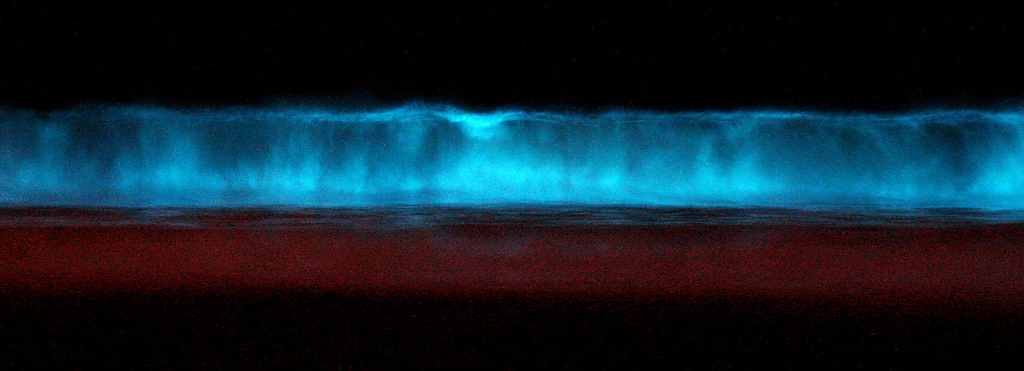
Red_tide_bioluminescence_at_midnight “Your principal concern appears to be that the Creator of the universe will take offence at something people do while naked.  This prudery of yours contributes daily to the surplus of human misery.” – Sam Harris, ‘Letter to a Christian Nation’
“How beautiful you are, my darling!  Oh, how beautiful!... Your lips are like a scarlet ribbon; your mouth is lovely… Your two breasts are like two fawns, like twin fawns of a gazelle that browse among the lilies.… Your lips drop sweetness as the honeycomb, my bride; milk and honey are under your tongue.  The fragrance of your garments is like that of Lebanon.… You are a garden fountain, a well of flowing water streaming down from Lebanon.

Awake, north wind, and come, south wind! Blow on my garden that its fragrance may spread abroad. Let my lover come into his garden and taste its choice fruits.” – Song of Solomon

‘I often think that the Church is totally untrustable in the area of eros.’ – John O’Donohue

‘Cultures that are repressed will be awful at f***ing.  They will decline.  And when they decline because they are awful at f***ing, they will create pornography, experience an epidemic of promiscuity, and cause wars.’ – Dorian Pankowitz, the man who introduced surfing to Israel, paraphrased (but only slightly)

Standing naked on a Costa Rica beach three Mondays ago around midnight, and a few minutes later being flung under and above and through water by tropical surf, as the moon stared down, oblivious to my body, or generous in its refusal to notice, it occurred to me that being naked on a beach in Costa Rica was exactly where I wanted to be.  As if there were nowhere else that I actually could be.  And when I say ‘I’, I mean something more full than my superficial sentiments about vacations and what you should do with them.  I mean something closer to my fullest interpretation of what I really am – a human being, made, if God exists, in the image of God; privileged, to be at a wedding in Costa Rica (although the guests had left by the time I went skinny-dipping); and with the possibility of significant change, just by standing naked on a beach under the moon.

Now the fact is that writing this seems unwise; that some readers may be offended by my nakedness, even though I’m only talking about it, rather than showing it off.  The fact that I have had to censor the f-word in one of the quotations above is part of this same continuum: we can't say the word in certain places for certain reasons, not least of which is the fact that it signals how afraid we are of our bodies.  But surely telling a story about how liberated I felt under the moon when I was naked can hardly be called exhibitionism?  I felt united with the sea – like I belonged there; like the earth was my home; like I fitted in my body.

It wasn’t a miracle; it wasn’t a transfiguration; and perhaps I'm the only person in the world who ever felt disconnected, or even a little dislocated from my physical frame; so this may mean absolutely nothing to anyone else reading.  If I were a poet, I could say this better - so if I'm de-railing your interest, please forgive me and come back later.  But if you're still with me, let me say this:  I found myself waking up a little bit more to the fact of my own body – that whatever else is going on in the world, I have nowhere else to be except in my body.  That’s where I happen.  Not just my fuelling-and-emptying; or my experience of sexuality; or work or play: but ME.  My body is where I happen.  It seems to me that Sam Harris is more right than he knows – it’s not just religious institutions that can turn the body into a site of oppression: for our entire culture may be obsessed with it.  The beauty myth forced on us by media and cultural mavens deadens the soul on the one hand; but on the other, the denial of the body still present in so much of our religious and educational systems detaches us from our very selves.  We wander round in bodies that we don’t like because someone else has told us that we don’t look ‘right’;  as if it were possible for six billion people’s hopes to be reduced to our potential to emulate the cheek bone structure of the rich and famous.

This may be turning into a rant, so I'll try to give it a soft landing.  I'm not sure that there's much more to what I want to say than the fact that I was naked on a beach in Costa Rica and it made me feel more alive than I was before.  But if there is something more, it is this:

I have nowhere else to be except in my body. Nothing happens to, or with, or through me apart from my body.  Yet even though we tell ourselves that we have left the dualism that divides physicality and spirituality behind, it's pretty clear that the competition for how we treat our bodies is still unsettled.  I need to tell myself that my body and I are better suited to befriending each other than denying who we are together.  I have a strong suspicion that the feeling of integration I had while naked on a beach in Costa Rica, while not denying the fact that some things are special because they're unrepeatable, isn't supposed to be the exception, but the rule.  I'm just not sure how to replicate it when I'm not on holiday.  But I know that, in the tension between being and becoming that I'm beginning to understand life to be, I want to.

*Photo credit: www.richarddawkins.net

The Most Important Film I've Seen This Year

hunger-1 I recently had the chance to see ‘Hunger’, the astonishing feature film debut of the visual artist Steve McQueen, which compelled audiences on its release last Autumn, and is now available on DVD.

The political responses to the film were predictable – but the film itself was not.  In the first instance, it is not, as was assumed, a film primarily about Bobby Sands, or even about the 1981 hunger strikes in general.  No historical knowledge of the socio-political context is necessary to understand or appreciate ‘Hunger’; in fact it’s likely that people outside northern Ireland will experience the film as a work of moral philosophy, while we locals may be unable to divorce ourselves from the traumatic memories of violence and sorrow that so many of us harbour, whether we know it or not.

‘Hunger’ is about the descent into dehumanization that every violent political conflict includes: the reduction of other human beings to ‘types’ and not personalities, sociological cohorts and not individuals with hopes and dreams and fears and pain.  In the film this descent has already taken hold; but we know that in our own society it began as such a reduction, and continued to form part of a deceptive and recursive narrative that, our history has shown can, unless it is arrested by a non-violent negotiation, end with genocide.

The film is in two parts, the first of which focuses on the daily existence – to call it a life would be an overstatement, it being so full of emptiness that it can’t be described as a humane experience – of a prison officer played by Stuart Graham (a magnificent portrayal of broken and brutal northern Irish masculinity).  He lives in a tidy middle class Protestant shell; with a quietly terrified wife, eating the same fry for breakfast every day, life regimented by the morning hand and face wash, the surreptitious pulling back of the curtains, the look under the car, the Puritanical schoolboy folding of tin foil sandwich wrapping, the punching he meets out to dirty protest prisoners, the tidiness of the flowers brought to his mentally frail elderly mother, ultimately leading to one of the most horrifying images I’ve ever seen in a film.

The second half begins with a long dialogue between Bobby Sands and a priest, tossing back and forth the question of the morality and purposefulness of the hunger strike.  This scene has been acclaimed by critics for taking such a long hard look at one thing: why someone would choose to die for a political cause.  Sands, as played by Michael Fassbender (it’s difficult to find adequate superlatives for his performance, so enveloped by the idea of what a human being would go through in starving to death), would call it a human cause before a political one; and perhaps substitute the word ‘inevitability’ for cause – so driven by what he sees as the forces of history to take this stand.

And after the talk, the agonizing death.  In this, as in the rest of the film, McQueen is both unsparing and subtle – elliptical scene giving way to elliptical scene, a lot of conversation followed by periods of almost silence, a memory sequence of Sands running as a child.  And then, it’s over; fade to black, a caption telling us how many died in the hunger strike, and how many prison officers were killed during the period, and how the prisoners’ demands were met.

For me, ‘Hunger’ might be the most important film yet made about northern Ireland and our shared trauma.  It is also the least one-sided (that doesn't mean it is without prejudice; and it's certainly neither a perfect film, nor an attempt at telling the whole story - none could, of course.  But for those of us who want our stories to honour the truth of the victims of violence without denying the brokenness of our society, 'Hunger' is a start.  A harrowing start that I wouldn't recommend to everyone, but a start nonetheless.)  No film has taken more seriously the horror of the taking of life by paramilitaries in the Troubles, nor the brutalization of some citizens by the state.  No film has more clearly stated that all violence against the person requires dehumanization; and that such dehumanization will always diminish the credibility of the cause (ostensible or real) of those carrying it out.  No film has upset me more.  And no film about my home has given me more hope.  I understand those who say they would prefer such films not to be made – that they stir up painful memories, or focus too much on those considered combatants rather than non-engaged citizens; but this film does not set out to lionize or demonise anyone.  It simply states what should be obvious, and a central part of what people who take being human seriously might be called to embrace: when one suffers, all suffer.  You can’t kill a person without tearing a part of yourself.

What I Thought I Always Knew About Robert Duvall

tender mercies What You Thought You Always Knew

1: That Robert Duvall is a great actor

2: That he won an Oscar for his performance in 'Tender Mercies'

3: That, despite the fact that you loved him in films as various as 'The Godfather', 'The Apostle', and 'Wrestling Ernest Hemingway'; that you have never been let down by a Robert Duvall movie (he even lifts 'Deep Impact' beyond cheesy melodrama with one of the most emotionally resonant final scenes a character has ever had in an American film); that just looking at the man's face grants you access to the secrets of the human heart; but for some reason you think this magic doesn't apply to 'Tender Mercies' because its title makes it sound like something you wouldn't want to see, and because he wears a cowboy hat on the poster, which for some unfathomable reason has also factored into your self-justification for not seeing it.

4: That, one day, you'd 'get around to it', but not until after you have seen everything else you want to see.

AND THEN....

An interruption.

You find yourself Robert McKee's Story Seminar (something you assumed you'd always get around to as well; but were unprepared for just how good it was), and he harps on about how 'Tender Mercies' is one of the best scripts ever filmed, and even though McKee is so concerned to convey this assertion that he tells you the whole story arc including giving away every possible spoiler, you decide that the first thing you need to do after the seminar is to watch it.

And you spend your Monday morning watching 'Tender Mercies', which does indeed turn out to be one of the most elegant, wise, discreet, and emotionally resonant stories told in Hollywood cinema; a story about something you don't exactly consider the most stimulating topic imaginable - country music, alcoholism, family and how they intersect - but turns out to be utterly gripping; a small story about a broken man trying to fix himself that eventually ends up looking like the story of the whole world; a film in which Ellen Barkin appears so beautiful she'd make you want to redefine the concept of screen beauty; in which Tess Harper gives the protagonist the most generous space to work with; and, yes, a film that leaves you wondering why you never found the time to see one of your favourite actors give one of his best performances.

This movie makes you want to love all the people you've neglected; touches the grief you have over your own regrets; and write a sentimental blog post.  And watch it again.