what we will do with ted haggard

so, ted haggard, president of the u.s. national association of evangelicals, leading crusader for the religious right, and, specifically, opponent of extending civil protection to same-sex couples has been accused of having a long(ish) relationship with another man, involving payment for sex and drugs. rev.haggard has acknowledged that some of the allegations are true, but the full picture has not emerged yet.

i wanted to write about this because i think i can predict what is likely to happen over the next few days, yet i am optimistic or naive enough to hope that there might be an alternative.

here's what i think will happen.

ted haggard will be treated with sympathy by some, disrespect by others, condemnation by still others. he may acknowledge more truth to the allegations. if they are true, he is not likely to acknowledge anything further than having 'made serious mistakes' and needing help to get through this difficult period. he will probably not say that he is gay or bisexual; he will try to distinguish between his behaviour and his identity. and he may (or may not) be right.

mike jones, the man who says he has had a relationship with haggard for three years will have a few minutes of fame, be vilified by the religious right, perhaps even accused of entrapment, and will then disappear from public view.

ted haggard's church will seek to support his own family.

the leaders of the religious right, in the form of rev.dobson, falwell, et al. will portray this as being a tragic story of a man who like david in the bible was brought low by temptation, but who has repented and can be restored to full ministry again. they will not alter their position on homosexuality.

some gay rights advocates will seek to make political capital out of the situation; expressing (perhaps legitimate) anger at haggard's hypocrisy, as well as some empathy for those whose closet is perhaps locked with an even bigger key than most, because their livelihood depends on it.

some ordinary gay christians who are seeking to maintain a traditionalist stance will feel terribly let down.

some will leave the church.

some others will feel justified in their rejection of faith.

and a man and his family, and another man and his loved ones, will have been the centre of a story about human frailty and what mark noll calls the scandal of the evangelical mind (though i don't assume that professor noll would agree with the rest of the assertions in this post - though i'd value his response to this situation).

it is more than an embarrassment that mainstream evangelicalism in the u.s. is unable to embrace intellectually rigorous responses to the human condition because on the surface they may contradict so-called 'biblical' views of the world. it is a scandal. truth be told, there is as much prejudice and love in the evangelical world than anywhere else. but ted haggard (or, if the allegations are false, we could substitute any number of other names of professional christians brought low by scandal) may have been spared this disaster if he had lived in a culture that isn't afraid to engage with scientific, social-scientific, and psychological responses to scientific questions.

in other words, and to put it perhaps a little too colloquially, the repression by the church for fifty years of ted haggard is not a manifestation of the grace of god; nor will the cause of the gospel of the kingdom of mercy and justice be served by condemning yet another of god's children who, in spite of the fact that he is guilty of hypocrisy, walks in places that have no map, because the church has refused to draw one.

borat is everything you could possibly imagine. or fear. or hope for.


so, a man pretending to be a television journalist from a former soviet republic goes to america and has fun at the expense of some of its people. much of the fun is in the service of exposing bigotry. it includes an old boy rodeo-type advocating the execution of gay people, a grotesque spoof sport called 'the running of the jew', and one of the fattest and hairiest men in the world wrestling naked with another man in the service of defending pamela anderson's honour.

yep, there are a couple of moments where i thought sacha baron cohen was using 'borat' to take advantage of vulnerable people, but it's unclear just how much the participants did or did not know about the film, so this is a difficult one to judge. the fact that there is a film out there which will attract an enormous number of people who may not normally engage that much with the politics of prejudice in a journey of such twisted hilarity i almost don't believe some of my memories of what is actually in it...well, surely this has to be welcomed.

the experience of vertigo


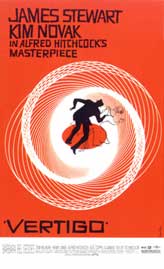
went to see vertigo at last night; the third time i've paid to see hitchcock's masterpiece on that particular big screen - if you've seen it, you probably understand why. there's something unrepeatable about the atmosphere of a cinema, the collective anticipation of an audience, and the feeling when the lights go down.

'vertigo' is, first and foremost, a bloody good thriller - whose superficially simplistic plot still manages to keep us guessing to the end. beyond that, it's a dreamland for the freud in all of us (if that itself is not a freudian slip). ultimately, this is a film about men and women, and the archetypal lack of understanding between us. it's about how we are tempted to make those we love into our own image; and how when love is lost, we may be drawn to do anything we can to get it back.

hitchcock wasn't known exactly for his healthy relationships, but then again it may well be the case that you don't have to be good to be wise.

the departed


go see 'the departed' - it plays like a compendium of scorsese's greatest hits, which is not a bad thing when you think about it; apparently he finished it just a week before it was released - and it shows with some rough edges. but with jack nicholson accepting direction from someone other than himself; leo and matt growing up; alec baldwin and mark wahlberg having some salty laughs; and martin sheen playing his first character who feels real since 'the west wing'. typically cool use of music - especially van the man embodying pink floyd's 'comfortably numb'.

it's also scorsese's most political film - a post-9/11 cry against the havoc of politics being done out of 'pure' self-interest. it's maybe not as important or smart as is being claimed by some, but i've seen it twice and didn't feel like it was anything other than a rather splendid use of my time.

Hunter S Thompson & Ralph Steadman

When Hunter S Thompson shot himself early last year, the journalistic world mourned one of its great mavericks – known for observing the past four decades of American life in books such as ‘Fear and Loathing in Las Vegas’. Thompson’s words are, of course almost umbilically tied to the cartoons of Ralph Steadman, the soft-spoken Welshman who illustrated the madness of the journeys Thompson took. Ralph Steadman has written an account of their relationship called ‘The Joke’s Over'.

Steadman begins the book by quoting Thompson saying ‘don’t write, Ralph, you’ll bring shame on your family’ – so he approached this with some trepidation…The two of them have been described as butch and sundance on acid – but that seems a little tame when you read the adventurous tales of hard drinking and living and driving.

What Thompson said in the search for the artist for 'fear and loathing': ‘what we need is someone already suffering from severe brain damage with a paranoic fear of government officials, and takes risks without realising what’s happening to him’. A sentiment with which many of us may resonate.

But this book is not just the story of a man’s creative life, it’s that of a man who interpreted the last forty years of US history, and may actually have taken his own life because he couldn’t stand what had happened to America under Bush - Steadman says that 'his American was dead'.

Of course, Thompson's great achievement was to create a new style of journalism - which he called 'gonzo' - of which Steadman says:

'Nobody I have read knows what GONZO is, was, or ever could be, not even Hunter, and if he doesn't know what it is, I do. I am the only one who does. Gonzo makes
you feel GOod rather than BAd, which is BANZO. Pursue BANZO if you must but don't blame me or even credit me or you will make me sick. GOnzo is GOod. BAnzo is BAd. It is a simple equation.'

Having said this, apparently Thompson believed that he 'would feel real trapped in this life if I didn’t know I could commit suicide at any time’, and so this is what he finally did. There is surely a degree of serious irresponsibility here and lack of concern for others - though his loved ones seemed prepared. Maybe he felt so close to his America that he felt he had to die with it.

Toward the end of the book there’s a lovely vignette that suggests there was something of a spiritual community with HST at the centre, and those involved must miss it desperately.