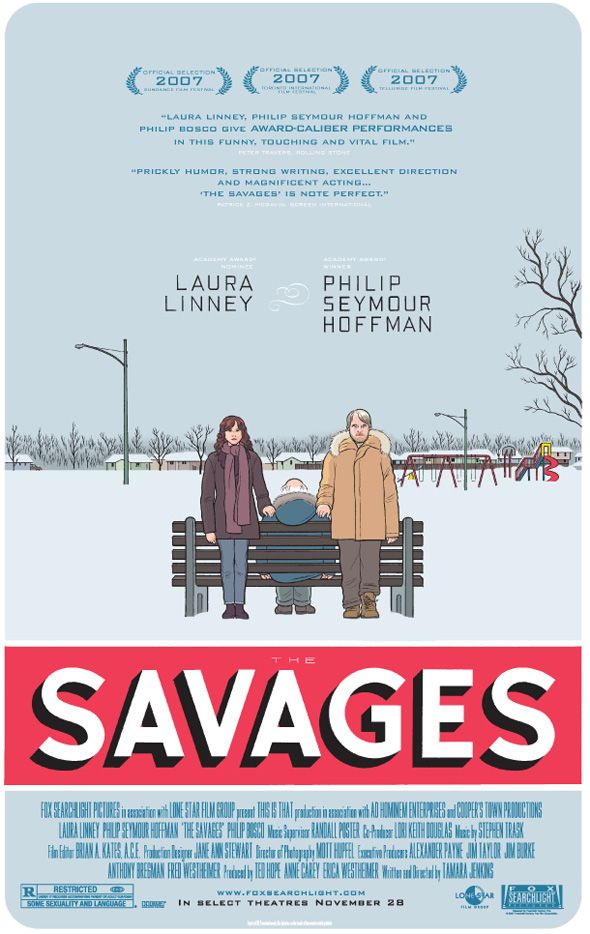
the savages


'the savages' has a joke for a title, in that it implies we haven't progressed much as a race since the prehistoric times when throwing bones in the air was the height of creativity, or even more recently, when the european medieval homicide rate was 50% in some places (you had a one in two chance of being murdered by someone you knew in the days of the black plague, the early inquisition, and orlando bloom's inter-faith dialogue). 'the savages' is about siblings trying to care for the elderly father who didn't treat them well, and whom they don't like very much. in that sense, it is about living and dying, and, in the context of contemporary medical culture - which can keep people alive far longer than ever before, leading to the inevitable fact that one day, someone is going to have pull the plug. savage indeed. or at least potentially so.

there are dozens of movies about 'dying well' - from 'stepmom' to 'terms of endearment'; and even though these have a reputation for over-egging the sentimentality, i don't mind them that much. we all have to deal with the death of loved ones; this is hard enough without taking away the comfort that a 'soft' movie might bring to the bereaved. though, of course, in these movies debra winger and susan sarandon don't exactly die like we do in real life.

'the savages' wants to present something more honest; and in philip seymour hoffman and laura linney's brother and sister pair, and most especially philip bosco's father, portrays a painful little play. these are characters with whom you sympathise, rather than like. they make bad decisions. they are self-centered. they have a little bit of heart. it feels like real life.

no magic solutions present themselves; but facing the death of a parent does in some sense help the children grow up, if only a little. and the movie ends with a motif that some may find grating, but i think is one of the most honestly life-affirming images in the movies.

read more of my film posts and the ongoing conversation with jett loe at the film talk website

walker: the anti-wanted


alex cox is one of those film-makers with a committed following among people who have managed to discover his work against the odds: his movies don't get shown in too many multiplexes, and you're not likely to find a trailer for them on websites linked to 'people' magazine. most of us know him for the weirded-out sci-fi/property developer film 'repo man', but i just spent part of a cold and sunny saturday afternoon in the company of 'walker', his 1987 piece about the involvement of an early form of neo-con 'take over the world' impetus in mid-19th century nicaragua.

in this movie, massive-scale violence is the inevitable corollary of imperialism, and (bad) religion and (selfish) politics combine to produce a sorry mess; one whose legacy still unfolds today. william walker, as played by the mighty ed harris, is what james mcavoy's character in 'wanted' would become if he ever hired a spin doctor. and the difference between 'walker' and 'wanted' is that alex cox understands that it's possible to make an entertaining film about violent people without falling in love with them.

Wanted


well, now that i've seen it, certainly not by me.

this is one of the most grotesque, patronising, blunt-edged, monotonous films i've ever seen. the question of what kind of meaning we bring to our own lives is an important one; and movies of course can be as good as any other creative media at exploring it. but 'wanted' appears to suggest that the two options available to every ordinary bloke today are simply these: act out the role of vladimir or estragon, droning away at an office on stage at a theatre of the absurd, or to kill everyone you meet. 'what the f*** have you done lately?, asks james mcavoy before the hard electric guitars start over the end credits, underlining the nihilism he's just given his soul to. well, for one thing, i know something i'm not going to waste my time doing again.

hope and dealing with the past

A Thought for the Day that I gave on BBC Radio Ulster this morning

We talk a lot these days about dealing with the past; which in itself is a pretty deep concept. I’m convinced it’s far better to try to address the profound sorrow of our recent history than to bury it along with our dead. And yet, talking and thinking about the past can leave us trapped in it – we may find ourselves spiraling into a cycle of revenge in which our conversations are colonized by blaming each other for the pain with which we allowed ourselves to be defined. It brings to mind the image of a person tied to a waterwheel trying to stay dry, and managing to keep out of the water for a few moments at a time. But the wheel just keeps on turning, and the person never lets go.

Where does hope come from in a world where we remain fixed on sorrow? It’s easy to be superficial about hope. It’s easy to talk about the well-known figures of historic peace and justice movements who are held up as examples that we should follow. But, with all due respect to the Gandhis and Martin Luther Kings of this world – because God knows we owe them respect – sometimes I think they are not the most helpful icons of how ordinary people might live peaceably – and hopefully – in a difficult world. To start with, they were public figures, leading public lives. Most of us, naturally, are not scrutinized as they were. We have to get on with the business of finding meaning amidst ordinary work, family pressures, bad weather and mortgages.

So let me offer this story instead. A friend of mine once asked a Holocaust survivor what he feels when he hears a German accent. The man, who had nearly died in a Nazi concentration camp said, ‘It took days for the train to take me to the camp. In the early hours of each morning, the train stopped for a break. And every morning, German villagers came out of the woods, and put food through the slats of the train to feed us. So when I hear a German accent, before I allow myself to think: That person might be the son of the people who tried to kill me; I think: That person might be the son of the people who tried to feed me.’

The story should speak for itself; but if any interpretation is needed, to me this story speaks of how hope does not to have to rely on the future actions of our enemies, whoever we consider them to be, but on the fact that they had more in common with us to begin with than we may ever have realized.

in defence (?) of m night shyamalan (part 2)


as for lady in the water, here's what i wrote on its release two years ago:

M. Night Shyamalan believes in magic, and he wants us to as well.

He also has an inflated sense of himself.

This is not unreasonable, given that his first major film ‘The Sixth Sense’ launched him at the turn of the millennium as a Hollywood wunderkind, capable of making thrillers so tight they were worthy of the adjective ‘Hitchcockian’, and even seared a new phrase ‘I see dead people’ onto the cultural lexicon. He followed ‘The Sixth Sense’ with another Bruce Willis-starrer, ‘Unbreakable’ – a film that captured the minds of many a Pentecostal youth leader eager to talk about the weight of spiritual vocation, a theme underlined by his next film ‘Signs’, in which the then uncontroversial Mel Gibson (oh how times have changed) played – of all things – a Lutheran pastor in the midst of a crisis of faith. He remained the critics’ (and the audience’s) darling until 2004, with the release of his post-9/11 analogy ‘The Village’, among whose many fans are myself and only one other person I can think of. It’s clear that he loves movies, and that he wants to conjure the same feeling we all used to share as children transfixed by the happenings on-screen – Magic.

And this is what he’s trying to do with ‘Lady in the Water’, a self-styled ‘bedtime story’ about a mermaid/angel hybrid called Story who arrives in an apartment complex in 2006, to warn its residents of how far humanity has strayed from the path of good. Or at least that’s what the opening titles suggest. This notion – that there is ancient wisdom that could save us, if only we would return to the Source – has obvious Christian resonances, that echo in all of Shyamalan’s other films, but the Story in this movie either loses the point, or fails to make it clear in the midst of a somewhat incoherent narrative.

To be sure, there are visual flights of fancy (shot by Christopher Doyle – Wong Kar-Wai’s photographer of choice) that entranced me, and the central performance from Paul Giamatti proves that ‘Sideways’ was not a one-off. But it’s never clear just what Shyamalan is trying to convey through his disappointed characters, and the none-too subtle repetition of television reports of how awful the world news is. Indeed, after the first hour, when I realised that the story wasn’t really the sum of its parts, I found myself feeling bored for the first time in one of his films. There are myths, there are monsters, there are quirky characters aplenty – from a body builder committed to working out one side of his body only to a film critic who meets a sticky end (Shyamalan is clearly a man to bear a grudge)…but there is no overall sense of what the film is really about, or even who it’s for. Is it about one man’s pain, or the whole society’s fear of global terror? Is it about the spiritual vacuum in our world, does it champion or does it critique the gung ho vigilantism that could be a caricature of the Bush administration? Is it merely (and maximally, for these matters are not without merit) an attempt at creating a new fairy tale?

The reason the answers to these questions remain ambivalent is that I’m not sure Shyamalan has decided who his audience is. The film is so convoluted in places, and demands so much attention that it wouldn’t be out of place in a festival of surrealism. And in that context, it might be welcomed as an at least intelligent attempt at post-modern storytelling. But if this is the case, then Shyamalan is guilty of wanting to have his arthouse cake and eat it in a multiplex. A film that is marketed as a scary fairy tale for all the family needs to be a scary fairy tale for all the family, and not a complex narrative about guilt and loss if we’re not going to feel unnecessarily confounded.

Perhaps the key to understanding ‘Lady in the Water’ is the scene in which the film critic claims to know more about the story teller’s intentions than the story teller himself. It’s obvious, and even quite amusing to see Shyamalan take his revenge on the critical family who appeared to mass ranks against him on the release of his last film. However, this attempt at being self-referential leads him to appear ultimately egotistical in the worst sense – in the final analysis, ‘Lady in the Water’ becomes a film about how Important the director thinks his work is. He even plays a character who is told of his cultural and political significance by a divine being (a plot element that would seem less egregious had he not played the character himself). This makes the film at least interesting to those of us who care about peace, justice, and what in ‘Superman Returns’ - another film with Christian resonance released this summer - was referred to as ‘all that stuff’. But it left me only with a feeling of disappointment, confusion, and the desire to sit down and have a good conversation with the director about his worldview and motives, rather than watching the film again. It still has more imagination and ambition than ‘Pirates of the Carribean’ and every other summer blockbuster put together, and perhaps we should be grateful that with ‘Lady in the Water’, Shyamalan has finally broken free of his apparent need to have a major plot twist at the movie’s climax. Next time around, let’s hope he doesn’t forget the plot in the first place.

For thoughts on 'The Happening', check in with www.thefilmtalk.com this Friday...