Sundance Festival 2: Mary and Max

One of the surprises of this year’s festival is that the opening night film is a stop-motion animation about the penpal relationship between a lonely Australian girl and a profoundly overweight man with Asperger’s Syndrome living in New York. If ‘Mary and Max’ had been a live action drama starring Philip Seymour Hoffman and Toni Collette, featuring elegant images of the Manhattan skyline looking like you’ve never seen it before, intercut with a knowing reflection on human isolation and the things that can heal it, this would appear to be the perfect choice for the world’s best known independent film festival. The fact that it’s made of plasticine instead of live action makes it so much more interesting than so many other independent dramas; it was good to see it as the opening night film.

‘Mary and Max’ is sensitive to Asperger’s syndrome and other special needs without being cloying; it’s honest about depression; it’s extremely funny in places without falling into the slapstick trap; the narration from Barry Humphries is perfectly balanced between sweet and harsh (and Hoffman/Collette both articulate what these characters might actually be like the real world); and, most of all, the animation - which took 57 weeks of days that each produced no more than a few seconds screen time is magnificent. Tonally think ‘Wallace and Gromit’ meets ‘Rain Man’ - with the emphasis on the rain. Director Adam Elliott has made an exhilarating film that genuinely deserves a huge audience when it’s released.

'The Wrestler'

Mickey Rourke plays a version of himself and every other faded star. He’s great.

Marisa Tomei plays a version of the hooker with a heart of gold who’s been around since cinema began. She’s risky.

Evan Rachel Wood plays the angry abandoned daughter archetype. She’s pretty good.

And the wrestlers are great fun; unsurprisingly sweet-natured and kind to each other.

But the film itself…

Well…it’s not that it’s not very good - it’s a well-made, honest little drama of the kind that looked original in the early 90s (think Soderbergh and James Marsh at the beginning of their careers) but there’s nothing in this film that I haven’t seen before. Stories are stories are stories, I suppose; and there aren’t too many to go around, and I’m delighted to see anything that denies the quick fix cosmetic ease with which movie characters often resolve their problems - even ‘Changeling’, perhaps the bleakest story I saw at the cinema this past year, had to have a ‘happy’ ending of some kind. Am also, as listeners will know, a fan of Darren Aronofsky - ‘The Fountain’s one of my favourite films, and ‘Pi’ and ‘Requiem for a Dream’ are so effective at building a mood of dread that I don’t ever want to see them again. But ‘The Wrestler’ is a B-movie; I think what saves it is that that’s what it seems Aronofsky was trying to make.

'Gran Torino'

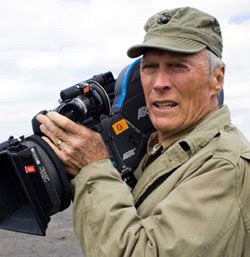
I heard a seventy-eight year old man sing, through a cracked voice, one of the most moving and gentle jazz melodies, as the iconic image of a fetishised sports car being driven into the sunset were projected. And, not for the first time in recent years, I was crying at the end of a Clint Eastwood film. 'Gran Torino', like 'Million Dollar Baby', 'Flags of our Fathers' & 'Letters from Iwo Jima', 'Mystic River', 'A Perfect World', and starting with 'Unforgiven' and 'Bird' twenty years ago, is a film about a man coming to terms with death, and being confronted with the futility of violence. I'm struggling for a word here, but I'll call it the 'joy' of watching this old man working at the peak of his directorial skill - simple set ups, scripts that sound like the way people talk in real life, often lots of unknown actors filling out the cast so the show becomes less of a celebrity-spotting exercise, sparing use of music (usually written by Eastwood himself) combining to produce not only one of the most prolific bodies of work in Hollywood history, but one of the most artful.

Sure, he has made some awful movies - but, as Groucho might say, haven't we all? For every 'Firefox' there's a 'High Plains Drifter' (one of the most gripping - and violent - revenge fantasies I've ever seen, and an early example of Clint's antipathy toward the church) or a 'Bird' (the second best film about jazz ever made, and maybe the best biopic); for every 'Blood Work' there's a 'Bridges of Madison County' (trust me, how many films about love between men and women actually make you believe they're in love?) or an 'A Perfect World' (a film which the Coen Brothers surely relied on for developing the Tommy Lee Jones character, world-weary sherrif, in 'No Country for Old Men').

'Gran Torino' might be the last film Clint Eastwood acts in. So it's a relief - and somewhat bittersweet - for me to report that I think it may be the best performance he's ever given; or at least the best from the twilight era of his life. There are moments in this film that speak to me about my own preoccupation (some would call it an obsession) with violence and non-violence, and I find myself astonished that these ideas come from man who, when he was my age, was playing characters who shot people dead in order to get a laugh. Agreeing with the philosophy outlined in a film is not, of course, enough of a reason to think it's a great movie. And perhaps if I watch it again in a week or a year or two I'll be disappointed (even on the first viewing there are some obvious wrong notes); but for now, I'll say this. The ghost of Dirty Harry is laid to rest. The brokenness of war veterans is honoured while the powers that be, who send young men to die for politics are utterly absent. This film knows that the future of humanity depends on people being able to live together in diversity, putting up with cultural difference, and defending vulnerable members of the community. But it also knows something that the Man with No Name and Dirty Harry didn't: violence begets violence; and only non-violence is powerful enough to neutralise its opposite. How 'Gran Torino' presents the terms of conflict, or how it ultimately addresses them, may not be a textbook example of Gandhian resistance, but it's a far cry from 'Go ahead, make my day'. On the first viewing at least, it's a heartbreaking, beautiful film. If it proves to be its director's last, while I'm greedy for more, I can't thinking of a more fitting swan song.

'Gran Torino'

I heard a seventy-eight year old man sing, through a cracked voice, one of the most moving and gentle jazz melodies, as the iconic image of a fetishised sports car being driven into the sunset were projected. And, not for the first time in recent years, I was crying at the end of a Clint Eastwood film. 'Gran Torino', like 'Million Dollar Baby', 'Flags of our Fathers' & 'Letters from Iwo Jima', 'Mystic River', 'A Perfect World', and starting with 'Unforgiven' and 'Bird' twenty years ago, is a film about a man coming to terms with death, and being confronted with the futility of violence. I'm struggling for a word here, but I'll call it the 'joy' of watching this old man working at the peak of his directorial skill - simple set ups, scripts that sound like the way people talk in real life, often lots of unknown actors filling out the cast so the show becomes less of a celebrity-spotting exercise, sparing use of music (usually written by Eastwood himself) combining to produce not only one of the most prolific bodies of work in Hollywood history, but one of the most artful.

Sure, he has made some awful movies - but, as Groucho might say, haven't we all? For every 'Firefox' there's a 'High Plains Drifter' (one of the most gripping - and violent - revenge fantasies I've ever seen, and an early example of Clint's antipathy toward the church) or a 'Bird' (the second best film about jazz ever made, and maybe the best biopic); for every 'Blood Work' there's a 'Bridges of Madison County' (trust me, how many films about love between men and women actually make you believe they're in love?) or an 'A Perfect World' (a film which the Coen Brothers surely relied on for developing the Tommy Lee Jones character, world-weary sherrif, in 'No Country for Old Men').

'Gran Torino' might be the last film Clint Eastwood acts in. So it's a relief - and somewhat bittersweet - for me to report that I think it may be the best performance he's ever given; or at least the best from the twilight era of his life. There are moments in this film that speak to me about my own preoccupation (some would call it an obsession) with violence and non-violence, and I find myself astonished that these ideas come from man who, when he was my age, was playing characters who shot people dead in order to get a laugh. Agreeing with the philosophy outlined in a film is not, of course, enough of a reason to think it's a great movie. And perhaps if I watch it again in a week or a year or two I'll be disappointed (even on the first viewing there are some obvious wrong notes); but for now, I'll say this. The ghost of Dirty Harry is laid to rest. The brokenness of war veterans is honoured while the powers that be, who send young men to die for politics are utterly absent. This film knows that the future of humanity depends on people being able to live together in diversity, putting up with cultural difference, and defending vulnerable members of the community. But it also knows something that the Man with No Name and Dirty Harry didn't: violence begets violence; and only non-violence is powerful enough to neutralise its opposite. How 'Gran Torino' presents the terms of conflict, or how it ultimately addresses them, may not be a textbook example of Gandhian resistance, but it's a far cry from 'Go ahead, make my day'. On the first viewing at least, it's a heartbreaking, beautiful film. If it proves to be its director's last, while I'm greedy for more, I can't thinking of a more fitting swan song.

Chinatown

‘Chinatown’ again last night.

New(ish) TV. New Blu-Ray player (though couldn’t watch the ‘Chinatown’ disc on it - my copy’s region 2 and haven’t figured out how to de-code Sylvania; so watched it on my perfectly acceptable forty-two dollar Phillips multi-region machine). No RGB cable (it’s connecting the Blu-Ray player). No HDMI cable (guy in the shop offered it to me first at $80, then said the cheapest he could do was $50. Went home, clicked three times, got one on amazon marketplace for less than two bucks. Should arrive tomorrow.) So, Region 2 ‘Chinatown’ using one awful lead - picture quality therefore reminded me of ‘Grindhouse’. Didn’t want to be reminded of ‘Grindhouse’.

‘Chinatown’. Probably for the tenth time. First time was a pan and scan late night ITV screening in about 1991. Second time was when I bought an early widescreen VHS copy, all gauzey - like when they put Vaseline on the lens to make an older actor look youthful, or to pretend that they’re dreaming. Got three or four viewings out of that tape. Then it was one of the first DVDs I ever owned. Now it’s the second generation UK DVD, apparently with a new transfer - though with one lead you can’t tell - but that’s my fault.

Ten times with a film is enough to make you complacent; but when it’s ‘Chinatown’ you could go on watching forever. I see new things in it every time. What I saw last night?

Politics.

Sex.

Violence.

The American Dream.

Cars.

Ambition.

Venetian blinds.

Sunshine.

Fish.

Throw in a bit of religion and you’d have the Great American Novel. Which is not far off saying that you might have America.