Some Thoughts from the New Book: What is America?

do-you-love-america-again I'm currently writing a book about how cinema explains my adopted country - the most well known art form of the US should reasonably be expected to be a key interpretative tool for understanding America, right?

I  don't want to give too much away at this point, but suffice to say, Oklahomans know how to dance, Massachussetts residents like sea food, and people from Illinois believe in any means necessary to stop other people drinking whiskey.

0000042007_20070813102815

What's most obvious from my research so far is that America  (and I use the term 'America' in the knowledge that I'm referring to the 48 contiguous states between Mexico and Canada, the large cold one to the left, and the exotic series of islands on the way to New Zealand.  I usually say 'the United States', but 'America' has become such a mythical term that it seems appropriate) hasn't settled its own mind about what it wants to be.

Kansas produced a militaristic President (Eisenhower) who later said that no glory in battle was worth the blood it costs.

Oklahoma - one of the most conservative states in the Union - also has the most registered Democrats.

The popular movies produced in the land that loves to call itself 'free' are disproportionately pre-occupied with the violent taking of human life for our viewing pleasure.

iron-man-vs-captain-america

America, in the movies, at least, is the definition of paradox.  And its mind is not yet made up.   Zhou Enlai is supposed to have said, in the 1950s, that it was 'too early to tell' the consequences of the French Revolution of 1789 - and that social movement was only thirteen years younger than newly constitutionalised America.  So then it's also too early to tell what America is.  Or maybe I'm misleading myself - for diversity of opinion does not necessarily equate to a lack of confidence in national ideals.  Maybe that's what America is: everything?

So, friends, I'd value any thoughts on the following question, in the comments section below:

What, in one sentence, is America?
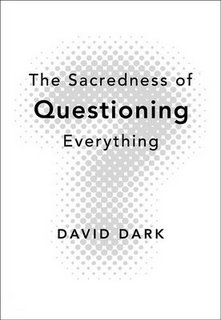
The Sacredness of Questioning Everything

david My friend David Dark has a new book out.  It's called 'The Sacredness of Questioning'.  It's a philosophical-theological-psychological-communitarianistical-nashvillianestical-cinematical-musical thrill ride.  It mentions the Coen Brothers, Flannery O'Connor, Tom Waits, and the mysterious figure who lives in the basement known as Uncle Ben.
And it manages to find new and interesting things to say about each of them

It's cultural commentary for people who don't think they like cultural commentary.

It's comedy for smart people.

It's religion for the sceptical.

It's very good indeed, and I'm not just saying that.

It has endless potential to delight and provoke, and I can think of no one who can read English who wouldn't appreciate spending a few hours in the presence of this very fine writer and communicator.  If you're buying a book any time soon, 'The Sacredness of Questioning Everything' really does deserve to be it.  There won't be anything else like it on your bookshelf (unless you own Dave's previous books, in which case, you already own the new one.)

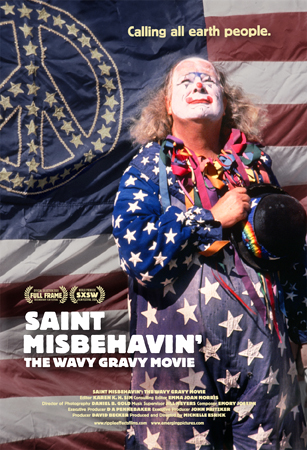
'Saint Misbehavin': The Wavy Gravy Movie

wavy_gravy_sm-1 Full Frame Day 2: There’s a man going round with a red nose making people smile; documentary festivals can be very serious affairs - from 10.30 in the morning it’s usually the case that we’re plunged into questions of genocide, disease, loss and sorrow. So it was more than a relief when I found Wavy Gravy in the room today.

I missed the sixties by 5 years, and am never sure if the mythology around the decade is the pharmacological residue of the various substances ingested by its protagonists, or the over-statement of a movement that failed by misty-eyed retired peace warriors.

They didn’t stop the war; they didn’t permeate the culture in any positive lasting way; they didn’t change anything, did they?

Hold on, I’m getting a little bit too ‘film critic burned out on not realising that being here is a privilege’.  Forgive me.  Please. That’s what Wavy would do.

A better question: What’s the problem with fun?  What’s the problem with trying to bring more love into the world?  What’s the problem with making people happy just by being in the same room?

‘Saint Misbehavin’, the film about the former Hugh Romney is dedicated to revealing that this clown is warm on the inside, I think; burdened for his poor and suffering brothers and sisters, and alive to the possibility that smiling can make almost anything better.

‘Saint Misbehavin’ is about people who were prepared to live beyond the narrow circle of self.  Living in community, sharing possessions, helping people look up from the difficulties of the everyday and enjoy it while it lasts, with a detour along the way to help save the eyesight of 2 million people (and counting) in the developing world.  The film challenges the notion that the sixties were mostly about self-indulgence.  Of course they  were nothing but indulgence for some; but we may together suspect they have their reward.

A great Scottish architect once told me that the purpose of architecture is ‘to help human beings live better’.  I don’t know if I’m what passes for a serious film critic or not; and I’m not even sure that I want to be.  Not that there’s anything wrong with that.  So I’m not certain if what I’m about to say is an academically rigorous theory of film, but watching this movie left me thinking that at least part of the purpose of cinema might be the same as designing buildings: to create a space in which people can find more of their better selves; to become the best of what is already within them.  ‘Saint Misbehavin’ isn’t necessarily the most aesthetically accomplished documentary I’ve ever seen, but when you’ve got this much humanity on screen it does everything I needed it to do.  (Have no fear, dear listeners, I haven’t lost it - that phrase can apply equally to ‘The Exorcist’, ‘Fanny and Alexander’, ‘Solaris’, ‘Magnolia’, and any number of other accepted parts of the canon.  I just happen to have had an uplifting experience with a delightful documentary today, that turned out to be far more substantial than ‘delightful’ implies.)

‘Saint Misbehavin’ becomes more than one man’s life story; it’s indicative of what living communally can be, and how human security depends on generosity, not fear.  It’s a modest work of art that wants to gently irritate accepted norms of human behaviour and respectability.  It loves all people.  It offers what its protagonist has dedicated his life to.  It wants to suggest that it is possible to harness the energy that all human beings have toward peace.

'Wounded Knee'

wounded-knee I am a European, and therefore an inheritor of a tradition that includes both life-enhancing, humanising political dissent (Mennonites and Amish, the Reformation, the anti-slavery movement) and racist, destructive control (conquests both political and economic, slavery, genocide).  I am a European, and so, even though I was not born when it happened, the 1973 seige at Wounded Knee, South Dakota, when locals from Pine Ridge co-operated with the American Indian Movement and others to control a town to make their case for justice, feels like it has something to do with me.  That, right now, as a northern Irish British citizen emigrant to the United States, I benefit from a system that disenfranchises first nations people to the present day.  (I suppose I could also say that as an emigrant I may also identify with the notion of being marginalised, but I wouldn't want to stretch the point.  Right now I'm in a nice hospitality suite, eating a croque monsieur, and covering a film festival for goodness' sake.)

'Wounded Knee', Stanley Nelson and Marcia Smith's telling of the story weaves the distant and recent past in the narrative - it's a potted history of the American Indian, so we get forced boarding education, the original Wounded Knee massacre, and the breaking of treaties alongside found footage of the 71 day long siege.  Contemporary interviews with the protagonists - from the Indian leaders of the siege to the FBI agents tasked with resolving the conflict - add more flavour than is often the case with this kind of film.

'Wounded Knee' is something more than a linear re-telling of an under-familiar story; the sorrow of the history of how this people has been treated by the nation that has sometimes seemed to claim for itself a monopoly on freedom is palpable.  In that sense it's an important document; it might seem churlish to raise questions like the ones I'm about to pose, but they were the ones that occurred to me while watching.

Is the lionisation of warrior traditions a necessary part of the process whereby an oppressed people's dignity is asserted?  In other words, do you have to endorse the use of violence just because it is employed by people who are suffering on the vulnerable end of a power dynamic?  Let me be clear: the film's sympathies lie where they should - with the people who suffer.  And its failure to ask whether the violence is justified does not equal an endorsement.

But those questions - which of course predate the suffering of American Indians, and doesn't show too many signs of going away any time soon - shouldn't get in the way of the rest of this film's context.

Brush strokes:

Dennis Banks declaring that his anger toward the government derives from the fact that his forcible boarding school education led to him never being able to regain the friendship he had with his mother.

The desperation that leads to a representative voice crying 'I believe that the time has come when we have to commit violence in order to be heard'

The fact that the owners of the looted trading post at Wounded Knee refused to leave, stating that, contrary to the government's assertion, they were not hostages, and that they would stay put until the demands of the siege operators were met.

As I've said, the value of this film is in the fact that it gives context to the reasons for why the siege happened.  The fact that it doesn't ask whether or not the tactics were justified is, in some senses, probably a matter of my own preoccupations (although I do wish for more documentaries about  responses to injustice that rely on force to be more inquisitive about the means/ends journey).  At the end, when the death toll has been counted (2 Indians dead during the seige; 60 in its aftermath, leaving Pine Ridge with the highest per capita murder rate in the country), and the elder statesmen and women of the movement have said their piece, one thing is clear: there is unfinished business to attend to.

More Thoughts on Non-Violence (2)

38126801dsc00685 Let's face it, some of us who hope to be inheritors of the peace activist tradition are regrettably notable for often lacking public credibility. While we all know people working at a grass roots level who can be held up as examples of the most heroic kind, often the public face of peace activism appears either ‘wooly’ or ‘strange’. In the UK, for instance, the de facto leader of the anti-Iraq War movement was an arrogant politician with a questionable ethical record, and without a meaningful strategy for addressing conflict.

In the US, Michael Moore’s tactics, while rooted, I believe, in a sincere sense of injustice, have alienated many people, and while striking, amusing, and sometimes moving, his more recent work has sometimes lacked the offering of a practical option for his audience to actually do anything to change the world around them.  This can change, of course, and I want to believe that Moore's best work is ahead of him.  Having said that, the stereotype of the grey-bearded, sandal-wearing hippy activist is both well-known, and not taken very seriously. (Note to grey-bearded, sandal-wearing hippy activists: I think you’re cool all the same. I hope one day to have a grey beard myself.)

Another challenge to non-violence being taken seriously is the sheer scope of violent threat, real or perceived, in the 21st century. The post-nuclear/‘war on terror’ age has the potential to leave us feeling overwhelmed by both the viciousness of the present human enmities, and what ‘our’ governments can do in return.

When planes fly into buildings, or when monks are tortured, or when whole governments are hi-jacked by a military coup or a 5-4 Supreme Court decision, or when 2 million people marching against Tony Blair’s support for the war in Iraq fail to stop it, it is reasonable to feel – initially at least – somewhat powerless. Reasonable, and initially, but not forever.

If you ask me 'How did Jesus raise the dead?' I will kiss you on the lips, and say 'like this'. - Rumi, still saying it, because I suspect he's still right

More thoughts to follow...